If you have logged into literally any software tool in the last twelve months and felt like you were about to be swallowed whole by a tidal wave of the words "AI Agent," you are not losing your mind. We’ve reached peak buzzword exhaustion. Every basic form, automatic email sender, and glorified spreadsheet has suddenly rebranded itself as an "autonomous agentic workspace." It's right up there with "chatbot" and "AI assistant" on the list of terms tech marketing departments treat like interchangeable synonyms. But they aren’t interchangeable. And cutting through this semantic nonsense isn’t just about being right—it is actually the difference between buying a tool that merely talks to your customers and deploying a digital employee that actually works for your business. Let’s break down the real, no-BS difference between a chatbot and an AI agent, and talk about what it actually means for your daily sanity and your bottom line.
A Chatbot Talks. An Agent Does.
Let’s start with a classic, real-world pain point. It’s 11:30 PM on a Tuesday. You are finally about to close your eyes, and ding—a lead form drops into your inbox. The prospect wants to know: "Do you guys have any openings this Friday morning for a consultation?" Here is how the two technologies handle this midnight interruption:
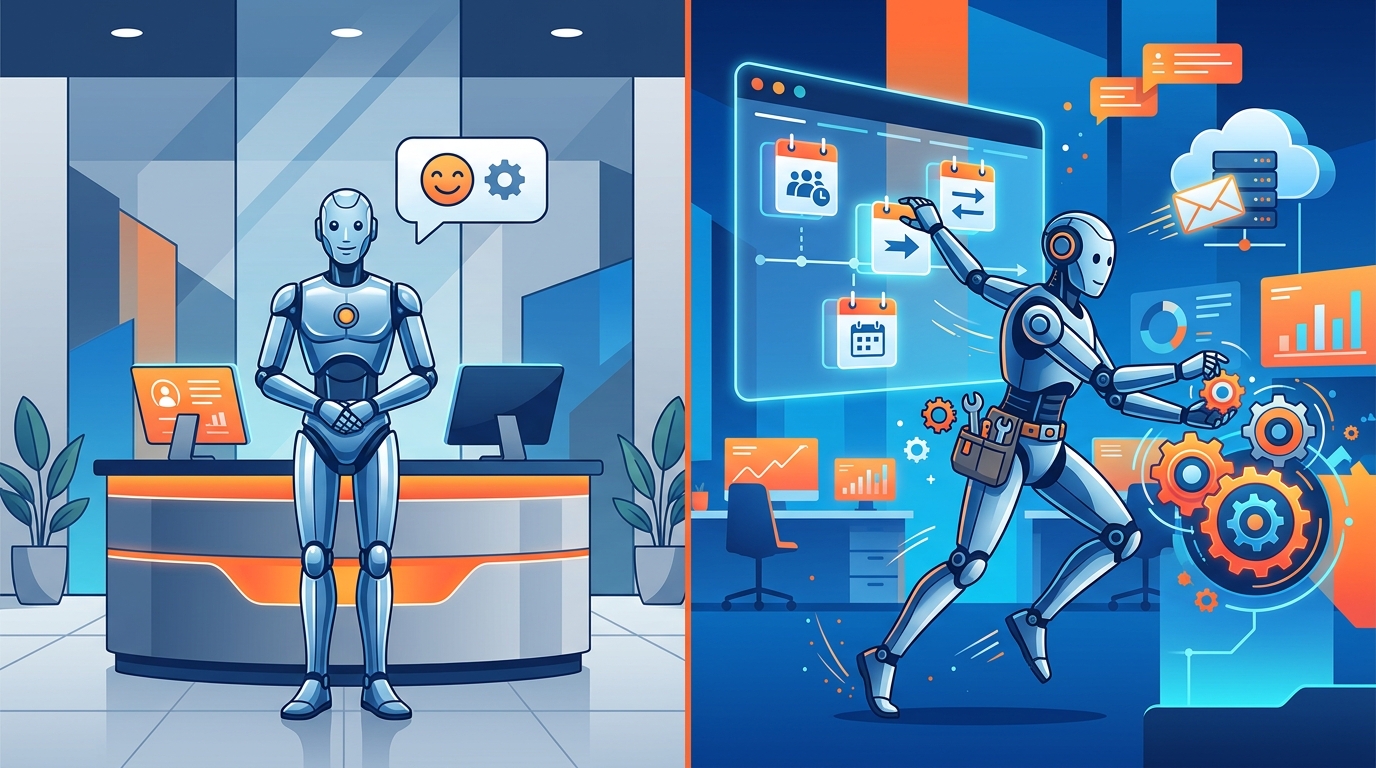
Scenario A: The Chatbot (The Conversational Store Greeter)
A chatbot is fundamentally a communication tool. You ask a question, it finds the answer in its database and says it back to you. Modern, LLM-powered chatbots are incredibly polite and conversational. They don’t just spit out rigid, robotic templates anymore. Your chatbot will happily reply at 11:31 PM: "Yes, we absolutely offer consultations on Friday mornings! Our standard hours are 9:00 AM to 12:00 PM. You can book an appointment by visiting our booking page or calling our office tomorrow." That is nice. It's helpful. But at the end of the day, the chatbot's job is done the moment it hits "send." It is a greeter pointing to a sign on the wall. The prospect still has to click the link, browse the dates, fill out their details, and finalize the booking themselves (assuming they don’t get distracted by a stray Instagram notification first).
Scenario B: The AI Agent (The Autonomous Go-Getter)
An AI agent doesn't just describe the solution—it executes it. When that same prospect asks about Friday morning, the AI agent doesn't just read its knowledge base; it actively connects to your real-time booking software, checks your availability, and takes action. Its response looks like this: "I see we have an open slot this Friday, October 9th, at 10:00 AM. Would you like me to lock that in for you?" The prospect replies: "Yes, please." Without a single click from the prospect or a midnight sigh from you, the AI agent:
- Reserves the calendar slot.
- Drafts and sends the calendar invite to both of you.
- Automatically triggers your onboarding email sequence.
- Updates your CRM status to "Scheduled."
A chatbot answers questions. An agent gets things done.
Why You Actually Need to Care About This
If you’re running a business, you already have a full-time job. You don’t have time to care about tech semantics unless they directly impact your wallet. Well, this one does. And it’s because of a quiet but massive shift in how the internet itself is starting to work: The Agentic Web. Right now, humans browse the web. We type things into search bars, click through three different websites, compare services, and fill out forms. But we are moving rapidly toward a world where our personal AI agents will do the browsing for us. Imagine your ideal customer telling their phone: "Find a local landscaping service with at least 4.5 stars, see if they can trim my oak trees next Thursday, and book whoever is under $500." Their AI assistant is going to go out, read the web, interact with local businesses, and book the service. If your digital presence is just a static website that only a human clicking around can understand, you become invisible to the digital assistants doing the buying. Businesses that have structured, clear data and interactive agents ready to talk to other agents are going to win the next decade of customer acquisition.
Where Small Businesses Should Actually Start (Without Losing Their Minds)
Before you panic-hire an expensive developer to build a custom, ultra-complex autonomous network that manages your entire inventory: please don't. Jumping straight to a fully autonomous AI agent handling refunds, modifying contracts, and moving money on day one is the fastest way to end up with a wildly expensive system that makes giant, automated mistakes. The smartest path forward is a realistic "crawl, walk, run" strategy:
- Start with a Smart Chatbot: Get a tool on your site that can handle 80% of the repetitive, brain-draining questions you answer every single day (hours, service areas, pricing tiers, FAQs).
- Build an "Agentic Bridge": Give your chatbot one simple, high-value action it can take. The absolute best starting point? Appointment booking or lead qualification. Let it talk and do that one crucial thing.
- Scale Wisely: Once you trust the system and see how your customers interact with it, you can slowly grant it more "doing" power—like pulling order statuses directly from your database or sending automated follow-up documents.
Think of it less like buying a rigid piece of software and more like planting a digital seed. You want to start small, but make sure you are planting it in a way that allows it to grow into a powerhouse later. Not sure where your business falls on the chatbot-to-agent spectrum? You don't have to figure this out alone. We love stripping away the tech hype to find out what actually makes your life easier and your business more profitable. [Reach out to our team today], and let's figure out what is actually useful for where your business is right now—and what is worth building toward for tomorrow.
Comments (0)
No comments yet. Be the first to comment!